


He didn’t believe in deodorant. The rare times he did brush his teeth, the sink would run red with blood. After working all day in the organic garden he managed, he would fall into bed, sleeping in his sweat stained clothes. I called him nomadic, those less charitable would’ve call him homeless: he’d travel seasonally, exchanging work for accomodation. He was kind of an asshole most of the time, and bizarre the rest.
I was utterly obsessed.
Let’s call him… Liam.
The lack of adherence to social norms didn’t repulse me. Instead, it attracted me, somehow - not exactly a moth to a flame - a fly to an overripe fruit, perhaps. I wanted to consume him entirely. When I described Liam to people, I couldn’t leave out his quirks, his transient rudeness. Friends and strangers alike fixated on our odd union, regarding with a mixture of curiosity and mild repulsion. They could not understand why I, a (at that time) bleach blonde, extroverted, part time influencer with a full time corporate job and American money (and teeth) was… well… “slumming it” (their words) with a man who had dirt perpetually caked under his nails, bad hand poke tattoos snaking his grimy body, didn’t treat me particularly well, and qualified for social welfare. But I would shake my head. They just didn’t understand - and I never saw it that way.
He was my swamp captain.
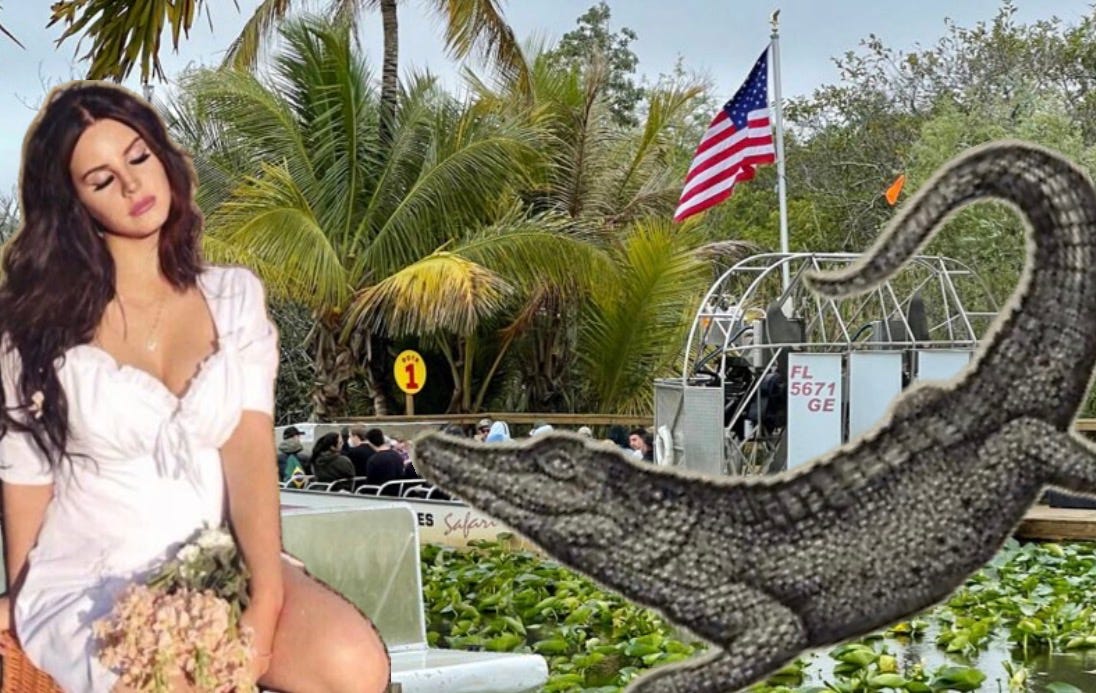
For those of you not chronically online: Lana Del Rey is a ethereal goddess of a women amongst mortals, a beautiful, heart wrenchingly talented singer / songwriter arguably best known for her (remixed into Forever 21 dressing room oblivion) 2012 hit Summertime Sadness.
After attending an everglades tour in Louisiana in 2019, she reconnected with her tour guide, Jeremy Dufrene, in 2024. She married him mere weeks after going public with the relationship.
The internet reaction was swift, speculative, and often cruel: commenters fixated on their physical mismatch, their age and professional gaps.
At this point, I should throat clear, politely clarify, and say something like: I’m certain Lana’s man is perfectly respectable and smells great.
Because it’s probably not true. And it doesn’t remotely matter.
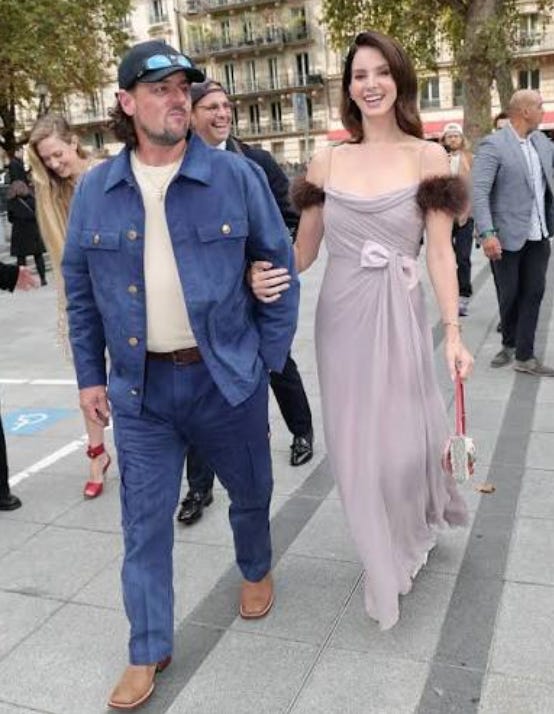
Here’s the part that doesn’t translate: Liam was completely unique. He was a gifted community organizer, cooking the most incredible, transcendent, mouth watering vegan meals, sourced entirely from his farm and whatever wild nature surrounded us. He didn’t need his own home, because his community opened up theirs to him: he’d serve us meals in sprawling haciendas, Italian chateaus out of your dizziest cottagecore dreams, seaside cabins perched upon rugged coasts - guests would come for the night and stay for weeks, so magnetic and welcoming was this man’s pull, the orbit of his followers.
He had an arresting gaze, tormented blue eyes blazing out from under a dark cliff of brow. And his hands. He had the most beautiful hands I’d ever seen. Roped with veins, long fingers. Strong enough to haul twice his weight, soft enough to place the most delicate spring bloom atop the handmade desserts he’d present to me from behind his back, smiling shyly. He spoke slowly and softly, choosing his words with a precision. Where sentences would tumble out of me, his were contemplative, considered. He laughed rarely, but when he did, he’d throw back his head, filling the room with it. I, perpetually filming, once caught it on video. I played it back dozens of times, tears in my eyes near the end of us.
The part I couldn’t articulate was that it was about permission. I can acknowledge I am conventionally attractive. I’m conventionally successful. With that comes the eternal burden of performance. I am never viewing myself, I am viewing myself through the lens of the man in my head, put there by the patriarchy. I remember in my early twenties, my teens even - carefully selecting lingerie, as if it even mattered, as if any man actually cared - all they saw was a willing body, lace clad, be damned. Self tanning, eyelash extending, hair bleaching - all to fit better into those norms, be more fuckable, more universally approved. I often felt as though I was beside myself, viewing myself from above. There was me, and then there was this flesh puppet that represented me - me, but also wholly separate, a thing apart. I was objectifying myself.
With him, the performance stopped. He’s one of the few people - er, men - that looked at me and saw me, past the meat, the avatar. He rejected social norms so completely that polite society found him vaguely repulsive. Yet within the strange moral universe he inhabited, everyone seemed equal. Beauty conferred no status. Femininity was an energy, not a performance. There were no scripts to follow, no points awarded for being desirable. And while he had his faults, his contradictions, he did, for the most part, embody his beliefs.
He once invited me to an energy release and meditation at a fire circle at the home of his childhood friend. Beforehand, I scrutinized myself in the mirror. I put on a body chain, layered a linen dress over it. I did my makeup. Afterward, in the glow of the campfire, I was struck by the utter absurdity of it all. I was surrounded by adults rocking, crying, laughing. We were white folk, stereotyped into oblivion, trying to transcend ourselves in the glow of the full moon. And there was I, choosing my outfit to sit in the pitch dark. I was struck by the utter absurdity of it all.
With him, I loosened the grip I had on myself. I began to exist, instead of perform. I became softer, grungier, looser. And ultimately, more myself. Or maybe he was simply a mirror, and I saw what I wanted to see. I can’t help but wonder if Lana could relate.
Cool essay. Every woman, at some point, mistakes the man in the mud for the way out of the mirror. He can be.
Beautiful.